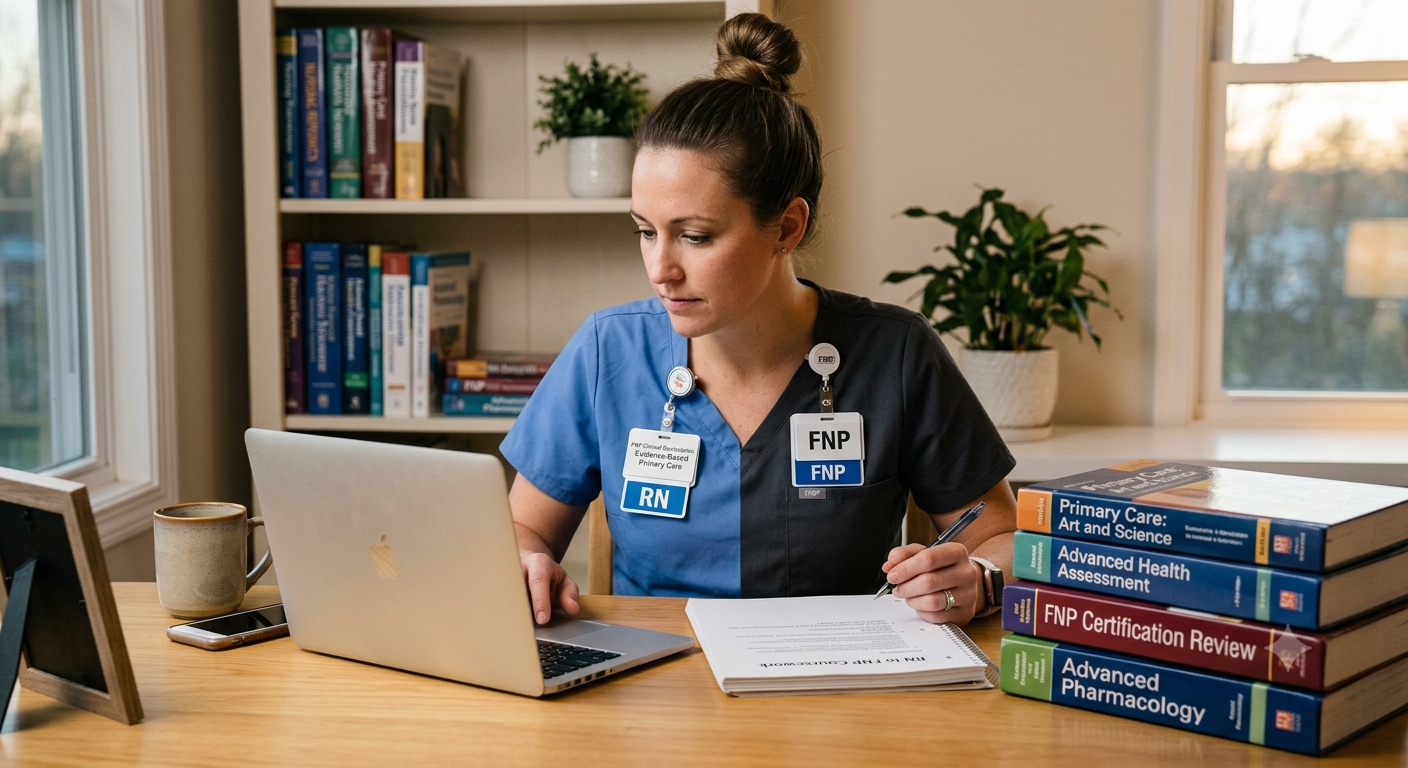
When looking into Family Nurse Practitioner (FNP) programs, students generally gravitate toward institutions that offer a balance of online flexibility, robust clinical placement support, high board-pass rates, and established institutional reputations.
The curriculum for accredited MSN-FNP programs is highly standardized by national boards to ensure safety and competency. Therefore, while exact course titles vary slightly by university, almost all top programs are built around the same foundational “Core” and “Specialty” tracks.
Three of the most highly preferred online FNP programs are detailed below, along with an elaborate breakdown of their typical course tracks.
1. Chamberlain University
Chamberlain is incredibly popular among working nurses because it holds the largest MSN-FNP program in the United States and offers “Practicum Commitment,” meaning they actively help students secure local preceptors and clinical sites.
The Course Curriculum
The program is split into 6 Core MSN Courses and 9 FNP Specialization Courses.
The MSN Core Track:
Foundations of Advanced Nursing Practice: Transitions the student from bedside RN thinking to the advanced practice mindset.
Leadership and Role Theory: Focuses on healthcare policy, systemic leadership, and the expanding role of the NP.
Evidence-Based Practice: Teaches how to evaluate medical research and translate clinical data into bedside practice.
Healthcare Policy and Leadership: Covers the economics, ethics, and legalities of modern healthcare systems.
Advanced Research Methods: Focuses on statistical data analysis and nursing science.
Informatics in Healthcare: Studies how electronic health records (EHR) and digital technology impact patient care.
The FNP Specialization Track (The “3 Big Ps” & Practicums):
Advanced Pathophysiology: Deep-dive into cellular disease processes and abnormal human physiology across the entire lifespan.
Advanced Pharmacology Fundamentals: Mastering drug behaviors, interactions, and basic pharmacokinetics.
Advanced Pharmacology for Care of the Family: Advanced prescriptive authority, focusing on the specifics of dosing for pediatric, pregnant, and geriatric patients.
Advanced Physical Assessment: Learning advanced diagnostic skills, comprehensive history-taking, and physical exam techniques (includes a virtual/on-ground immersion lab).
Differential Diagnosis and Primary Care Practicum: Formulating diagnoses for acute/chronic conditions and starting the first round of clinical hours.
Primary Care of the Maturing and Aged Family Practicum: Focuses exclusively on the complex healthcare needs and chronic illnesses of middle-aged and geriatric patients.
Primary Care of the Childbearing Family Practicum: Focuses on pediatrics, adolescent health, and obstetric/gynecological care.
FNP Capstone & Board Prep: A final synthesis course paired with a review curriculum to ensure students pass their national AANP or ANCC board exams.
2. Georgetown University (School of Nursing)
Georgetown is preferred by students looking for an elite, high-reputation Ivy-plus name on their résumé. They utilize a “synchronous” online model, meaning classes are live and highly interactive, paired with intensive on-campus skills weeks.
The Course Curriculum
Georgetown divides its intensive curriculum into foundational nursing science and highly specific lifespan management courses:
Foundational Graduate Core:
Professional Role Development: Understanding the legal, ethical, and collaborative boundaries of a primary care clinician.
Biostatistics and Epidemiology: The study of public health patterns, disease outbreaks, and clinical data interpretation.
Health Care Quality & Safety: Strategies for optimizing patient outcomes and minimizing clinical errors.
Advanced Practice Clinical Core:
Advanced Health Assessment: Advanced techniques in head-to-toe physical examinations and creating medical records.
Advanced Pathophysiology: Understanding the biological mechanisms of illness from infancy to old age.
Advanced Pharmacology: The study of pharmacodynamics, pharmacokinetics, and safe prescription writing.
FNP Primary Care Specialization Track:
Primary Care of the Family I (Adult & Geriatric): Diagnosing and treating common, chronic, and acute primary care issues in adults.
Primary Care of the Family II (Women’s Health): Comprehensive gynecological care, family planning, and prenatal/postnatal management.
Primary Care of the Family III (Pediatrics): Well-child visits, childhood developmental milestones, and managing acute pediatric illnesses.
Transitions in Health and Illness: A holistic course focusing on palliative care, mental health integration, and lifestyle modifications for families.
FNP Clinical Practicum I, II, & III: Sequenced rotations across family practices to fulfill the required 600+ patient-facing clinical hours.
3. University of Texas at Arlington (UTA)
UTA is highly preferred by students seeking an affordable, fully accredited public university with an accelerated, flexible online pace.
The Course Curriculum
UTA focuses heavily on evidence-based practice and a structured approach to clinical management:
Core Nursing Courses:
Nursing Research and Evidence-Based Practice: Applying peer-reviewed research directly to clinical scenarios.
Principles of Leadership and Quality in Healthcare: Learning how to manage clinics, delegate responsibilities, and lead healthcare teams.
Health Policy and Social Issues: Analyzing how socio-economic status and government policy dictate patient health outcomes.
The Functional Clinical Core:
Advanced Pathophysiology: Lifespan analysis of disease processes.
Advanced Assessment and Diagnostic Reasoning: Learning how to read lab work, diagnostics (X-rays, EKGs), and perform detailed physical assessments.
Pharmacology for Advanced Practice Nursing: Heavy focus on prescribing habits, narcotic laws, and medication safety.
FNP Specialization Courses:
Adult/Gerontology Primary Care: Clinical management of young adults through the elderly.
Pediatric Primary Care: Clinical management of infants, children, and adolescents.
Women’s Primary Care: Gynecological, reproductive, and preventative health for female patients.
Diagnostic Methods and Procedures: Hands-on training for minor office procedures (suturing, splinting, mole removals, etc.).
FNP Clinical Practicum & Role Seminar: The clinical immersion phase where students work directly under a preceptor to manage an independent patient load.
Crucial Tip for Comparing Programs
When choosing between these, remember that Core Courses are often asynchronous (log in and do assignments whenever you want), but the Specialization/Practicum stages will require you to secure a schedule with a local clinic to get your physical clinical hours done.
